
Dialog “Edit Transition”
The dialog opens:
- in a state machine when you click a state transition (red line with arrow) and right-click to select the context menu command Edit.
The dialog
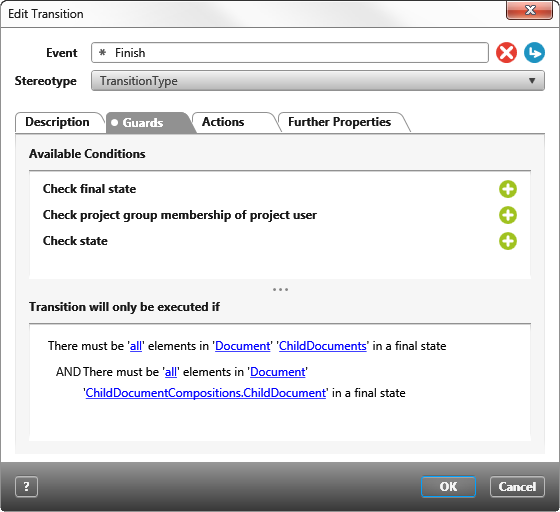
Event Here you can optionally specify an event that triggers the state transition. This event appears in the diagram next to the transition. If no event is specified, the event is not displayed in the element’s form. You have two options. You can either select the appropriate event from the events that have already been created or create a new one for this state transition.

Add event
Creates a new event

Remove event
Removes an event

Assign existing event
Opens a dialog, where you can apply a desired event from list
Stereotype Choose the appropriate stereotype from the drop-down list.
Tab “Description”
Enter a description.
Tab “Guards”
On this tab, you add guards that must be met for a state transition to be performed.
Under Available Conditions, you will find a list of all available checks. Select a guard that you want to use and click the Plus.
Under Transition will only be executed if occurs only if, you can specify the guard in more detail. Click the blue underlined terms to replace them with values. If you have added multiple actions, they are linked with “AND”.
If you want to link guards using OR, create multiple guards with the same source, the same event, and the same target. Make sure that the guards defined for the transitions are mutually exclusive; otherwise, you will get a random result.
Tab “Actions”
Here you specify which actions are triggered automatically by the state transition when the respective state is entered, reached, or exited.
Under Available Actions, actions are listed that are executed when the state transition occurs. Select the desired action to be executed and click the Plus button. The selected action is inserted under Action in case of transition and can be defined in more detail by clicking the blue links. If you have added multiple actions, they are linked with “AND”.
Tab “Further Properties”
If the stereotype has so-called user-defined properties, you can enter values for them here.