
Defining access rights for users and project groups
Functional scopes can be used to specifically define access rights for stereotypes and relationships and to show or hide context menu commands. This allows you to precisely control, for each role or project group, which actions are permitted and which menu entries should be visible.
Open a functional scope by double-clicking it.
Standard settings
A newly opened functional scope is empty by default – all permission buttons (List, Read, Write, Create, Delete, Change State) are inactive (grayed out).
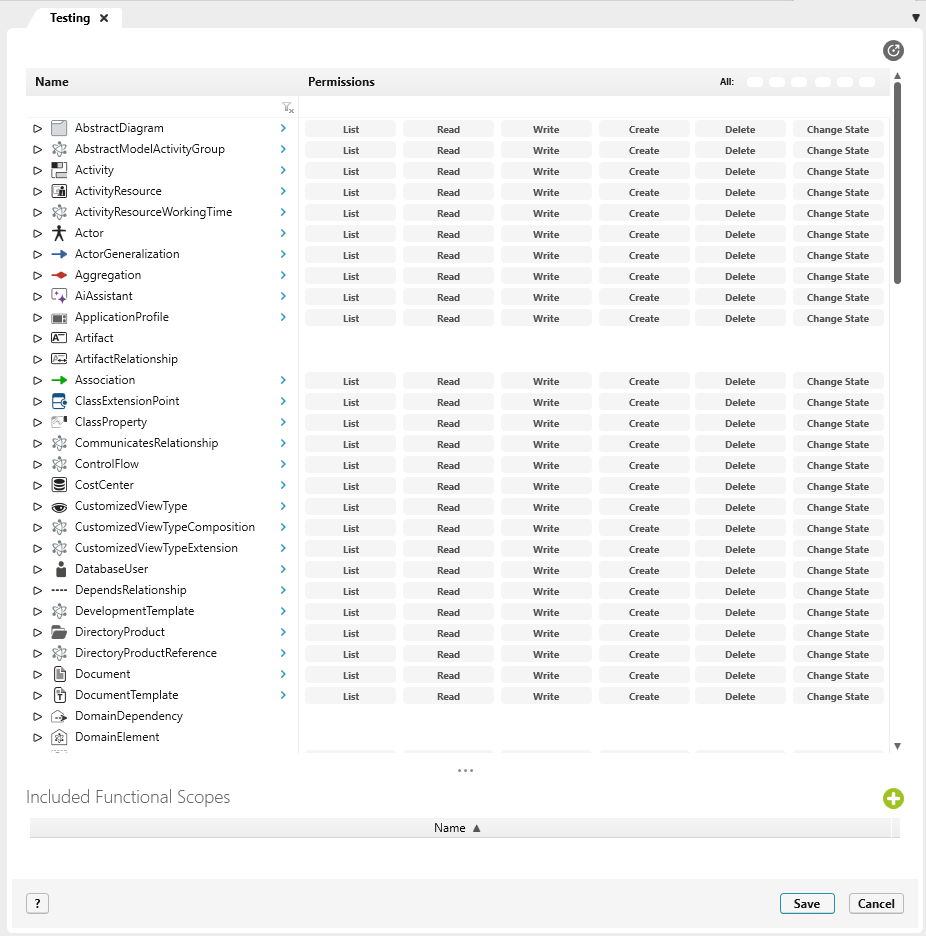
If you expand a stereotype in the functional scope, you will see the commands that can be accessed by default via the context menu of the respective stereotype. Select the entries that should be available in the context menu, or deselect those that should not be offered.
Permissions for stereotypes
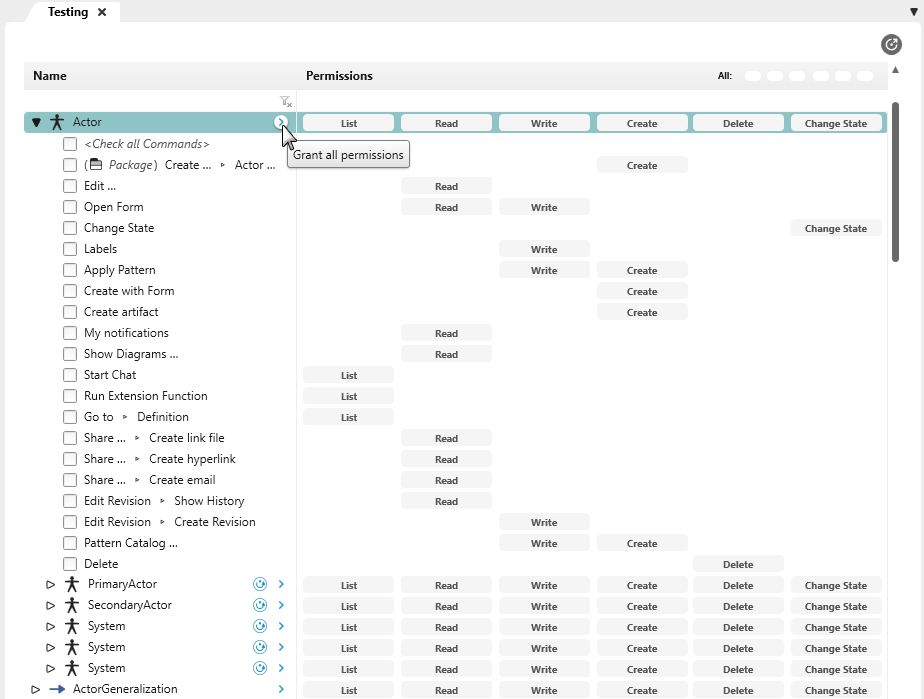
The display on the left shows the stereotypes in the order in which they can be found in the Stereotypes window. Scroll through the list until you reach the desired stereotype. Select it and click the blue arrow button to set all access rights at the same time. This also takes all context menu commands of the stereotype into account and selects them as well.
Inherit permissions
If a stereotype has additional sub-stereotypes, these are listed under the stereotype and are assigned the same access rights as those set for the parent stereotype using the Permissions are currently inherited button. This button is enabled by default.

If you want to restrict access rights to certain rights, simply click on the desired rights one by one. If you click on a right that requires another right, this right will also be set.
Example: You want an element to be created and therefore click on Create. To be able to create an element at all, the user also needs the List and Read permission. Accordingly, these buttons also become active when Create is clicked.

Permission for context menu
Even though requirements may be created and edited, you may want to hide some context menu commands because they are not needed or should not be used.
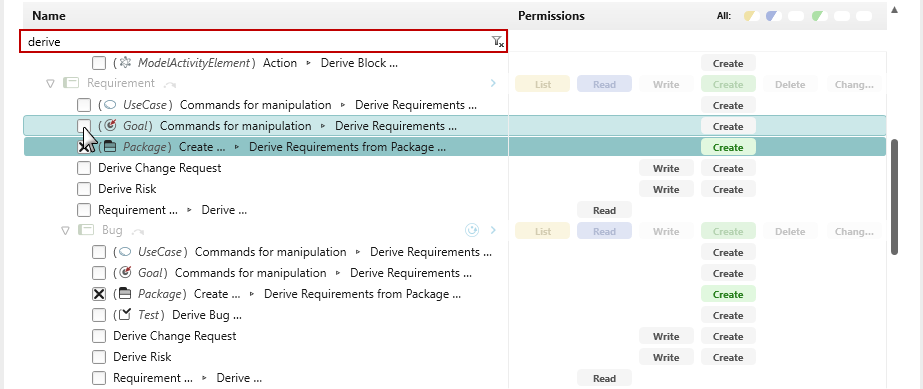
To do this, use the filter under Name and enter a context menu command in the field. Alternatively, you can click on the small gray arrow next to the filter. The filter offers filter options by keyboard input or selection. You can select filter conditions before the input field.
Commands that match the search are active and can be selected via the checkbox. The stereotype to which the command belongs is grayed out.
Permissions via buttons “List, Read, Write, Create, Delete, Change State”
The buttons can be used to assign permissions of one type (List, Read…) to all stereotypes with a single click. Which button you click depends on which access right is to be assigned. The button is filled with the color of the access right. The assignment is removed again when you click the button a second time.
